A description, with examples, of this pithy little number known as Essence poetry, created by Emily Romano, can be found here on the Shadow Poetry site.
Thursday, 26 May 2022
New Forms (36): The Essence Poem
Monday, 22 February 2021
New Forms (35): The Duplex
Monday, 11 January 2021
New Forms (34): Minison
I have just encountered the Minison Project here, thanks to Trish Hopkinson's NO FEE Submission call page.
Do take a look at this brief form, described as 'Shakespeare's Sonnet Reimagined'.
Saturday, 24 October 2020
New Forms (33): Roseate Sonnet
Details of the Roseate Sonnet can be found here. This Indian variation on European Sonnet forms was developed by Dr. A.V. Koshy in December 2012.
Monday, 28 September 2020
New Forms (32): The haiflu
#haiflu
The haiflu is taking off big time, and although I am presenting it as a new form, it is has really become a community enterprise initiated by Liz Torc, revolving around lockdown Haiku and photographs. We are being invited to post any we write online with a hashtag so that others can find them.
Thursday, 16 July 2020
Thursday, 18 June 2020
New Forms (30): the Suffolk Cando
![]() |
| '... so how did it get so green?' Dean Parkin (Suffolk Cando) |
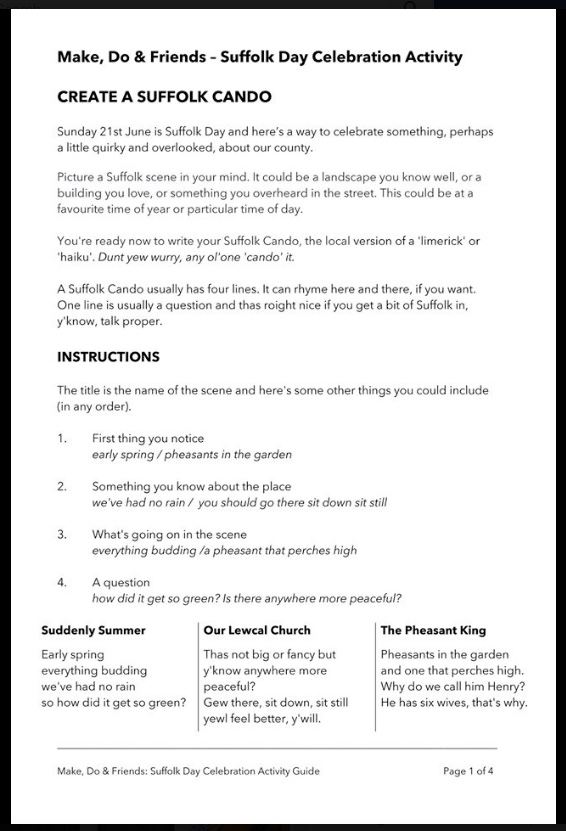
Have you heard of the Suffolk Cando? Poet, Dean Parkin invented the form for the Make, Do & Friends projects, organised by Suffolk Artlink and the Rural Coffee Caravan. He hopes it will help us to celebrate Suffolk Day on 21 June.
Dean describes the Suffolk Cando as a cross between a limerick and a haiku, with added Suffolk dialect thrown in. The form usually has four lines. It can include rhymes 'here and there'.
One line is usually a question, and while the inventor of the form would like to encourage a bit of 'Suffolk', he adds that 'any old dialect would do (or speech).'
The form will be premiered tomorrow on Radio Suffolk (UK) on Friday 19 June 2020 on the Lesley Dolphin show at 2.30pm.
Dean's examples:
SUDDENLY SUMMER
Early spring
everything budding
we've had no rain
so how did it get so green?
SUFFIN FOR NUFFIN
They say wos it all about?
Well, I dunt really noo.
You can do the hookey cookey
but just yew mind how yew gew.
Posted with Dean's permission.
Thursday, 30 January 2020
Poetics (6): the Epigraph
I suspect epigraphs are like a certain yeast-based spread in the sense that you either love or hate them. Dave Bonta and those who comment on his words have listed a number of reasons for their inclusion: you can find the discussion here on Via Negativa.
Labels:
Dave Bonta,
epigraph,
poetic structure,
Via Negativa
Wednesday, 30 January 2019
Sunday, 4 February 2018
Tuesday, 30 January 2018
Poetics (5): the Double dactyl
Do click the link here to read more about the Double dactyl on The London Grip pages for the time being.
Thursday, 30 November 2017
New Forms (27) and (28): The Octolune... and the Octoluneo
This new poetic form, which addresses or invokes the moon, was invented by Simon Zonenblick. If you click through to Simon's post and scroll down a little, you will also be able to read about the spin-off form, the Octoluneo.
You can find details of the Octolune on the Write Out Loud site here.
Alison Lock has included an Octolune in her new collection, Revealing the Odour of Earth (Calder Valley Poetry, 2017). Hannah Stone alludes to the poem in her review here on the Algebra of Owls site.
Labels:
Alison Lock,
moon,
Octolune,
Octoluneo,
Simon Zonenblick
Friday, 27 October 2017
New Forms (26): Newspaper Blackout Poems
As far as I can see, these are the same as erasure poems, except that you (only) use text from a newspaper.
See here.
See here.
Monday, 2 October 2017
New Forms (25): The Golden Shovel
![]() | ||
| This not-quite golden (?peat) shovel is displayed in the Somerset Levels, having come from the China Clay Museum in Cornwall |
24 November 2017 news update: there is now an international Golden Shovel competition run by Roosevelt University for young people and international undergraduate students: details here.
* * *
I attended a poetry workshop and reading at the ¡Cornucopia! Alde Valley Festival on Saturday. One of the poems read out to us by Sue Wallace-Shaddad was in the Golden Shovel form. This was new to me. Its name immediately brought to mind not only Wordsworth's 'host of golden daffodils', but a diverse array of other 'golden' items, rules and concepts - the goose's golden eggs, the Golden Section, a golden handshake and so on.
The image that lodged most firmly in my mind was the 'Golden Marshalltown' trowel, the prized possession of an archaeologist, in The Golden Marshalltown: A Parable of the the Archaeology of the 1980s by Kent V. Flannery (American Anthropologist, New Series, Vol. 84, No. 2, June, 1982, 265-278): you can read about the article here.
I am still trying to work out the connection between the trowel and the shovel since both (like the pen: remember Heaney) can be used for digging.
Here are a few links to websites about the new poetry form...
- the poem by Terrance Hayes that gave the form its name.
- about Terrance Hayes, the creator of the form and about Gwendolyn Brooks, in whose honour the form was created.
- concerning the rules, as laid out by Robert Lee Brewer
- The Golden Shovel Anthology: New Poems Honoring Gwendolyn Brooks, edited by Dr. Peter Kahn , Ravi Shankar and Patricia Smith. About the volume's launch - here.
- 'Prayer' by Carolyn Oliver, a Golden Shovel poem using lines from Emily Dickinson, on the Frontier Poetry site.
- Poetry School review by Bridget Minamore of Seasonal Disturbances by Karen McCarthy Woolf (Carcanet). The review mentions the poet's Golden Shovel poems which feature in the book.
- Excellent advice and help from Peter Kahn and the Young Poets' Network - here.
Tuesday, 19 September 2017
Resources (2): Martyn Crucefix on 14 Ways to Write an Ekphrastic Poem
Friday, 26 May 2017
New Forms (24): The Cherita
The Cherita: a compact and pleasing 'short form', with a sense of narrative at its heart.
- 'collecting dulse' [22/2017] has been published in The Cherita #3 (eBook 2017 vol i. Find Me) p.188...
![]() |
| Elgol, Skye shorelines |
Friday, 17 February 2017
Poetics (4): Structure... Metaphor-to-Meaning
For an excellent discourse on this fascinating subject, please see the post on the Structure and Surprise blog.
Monday, 19 December 2016
New Forms (23): The Alternating Sonnet
Please follow the link here to the Every Sonnet blog (and there are all kinds of other sonnets, too).
Monday, 7 November 2016
Monday, 12 September 2016
Poetics (3): The Volta
For John Keats and the 'turn', see here on Structure and Surprise. There is even a dolphin in the poem.
I have mentioned the following published lecture before on this blog, but here are the details again as a reminder...
You Only Guide Me by Surprise: Poetry and the Dolphin's Turn Peter Sacks. The Judith Lee Stronach Memorial Lecture on the Teaching of Poetry, delivered on 7 May 2010 by Peter Sacks.
Saturday, 10 September 2016
New Forms (21): Dizain
You can read about this compact 10-line form on Robert Lee Brewer's Writers' Digest page here.
Thursday, 4 August 2016
New Forms (20): Cinquerelle
'A Cinquerelle is a five line poem of
descending syllabic value, 15 syllables in all. So two less than a
haiku. The idea is to compress a cosmos into an atom.'
Description of the form from Michael Newman.
CINQUERELLE
Description of the form from Michael Newman.
CINQUERELLE
Waves against boulders;
Breakers unfurl.
White onrush.
Children
Squeal.
© Michael Newman (used with permission)
Breakers unfurl.
White onrush.
Children
Squeal.
© Michael Newman (used with permission)
Saturday, 16 April 2016
New Forms (19): Tanka Prose (aka Tanka-Prose)
![]() |
| '... the best strawberries ...' Tim Gardiner in his piece, 'Between Storms' |
We helped to organise an Open Mic evening last night in Ipswich on the theme of 'Treasure'. During the course of the evening, Tim Gardiner introduced me to Tanka-Prose.
I have attempted Haibun (prose with Haiku) in the past, but had not heard of this alternative form. Tim explained a little about Tanka-Prose, which hasTanka rather than Haiku as a key element.
- 'Toward a Theory and Practice of Tanka-Prose' by Charles D. Tarlton, Oakland, California, USA (Haibun Today, Volume 5, Number 4, December 2011)
- Tim Gardiner's Haiku-Prose, 'Between Storms', published in Haibun Today, Volume 10, Number 1, March 2016
- 'The Elements of Tanka Prose' by Jeffrey Woodward
- Tanka Prose resources from Ray's Web (Ray Rasmussen)
Saturday, 2 April 2016
Reference Post (2): Outlets for Formal Poetry
Outlets for Formal Poetry
- A selection can be found here on the pages of 'A Selfish Poet' on Trish Hopkinson's site.
Thursday, 20 August 2015
Literary Forms with Poetic Implications: (3) Mesostic poetry
'Mesostic' was a new word for me. I encountered it on Alec Finlay's page, where it appears several times in relation to his poetry collections.
For a definition of Mesostic, I turn to Wikipedia ...
Friday, 15 May 2015
Resources (1): Useful Books (currently a list 'in progress'...)
The Book of Forms: a Handbook of Poetics Including Odd and Invented Forms by Lewis Putnam Turco (UPNE 2012)
ISBN-10: 1584650222 AND ISBN-13: 978-1584650225
A constant source of inspiration for many years.
(QQ Press in two parts, UK, £6 incl. of p&p. Rest of world postage on request).
Part 1, by Bernard, covers 37 forms.
Part 2, by Alan, is a glossary of literary and poetic terms.
Muse & Metre by Dr. H. Tulsi, ed. of Metverse Muse (India) - and Bernard M. Jackson
Moving Words, Forms of English Poetry by Derek Attridge (OUP).
242 Mirror Poems and Reflections by Dr Marc L. Latham (Kindle or print edition)
You Only Guide Me by Surprise: Poetry and the Dolphin's Turn by Peter Sacks.
The (brilliant) Judith Lee Stronach Memorial Lecture on the Teaching of Poetry, delivered on 7 May 2010 by Peter Sacks.
Thursday, 7 May 2015
Literary Forms with Poetic Implications (2): Univocalism (plus Lipogram and Transgram)
![]() |
| ... 'neglected by legends' ... Leanne Moden |
A Univocalism is a piece of writing, emanating from the constrained writing techniques of Oulipo. A Univocalism only allows for the use of one vowel, which may be repeated.
There is a rather good poem, keep my secret, in this style here on the Cambridgeshire NaPoWriMo site by Leanne Moden of Ten Years' Time.
- Univocalism listed on the Found Poetry Review (and here)
You might also enjoy reading about, or experimenting with, the Lipogram, a 'back formation' with a long history ...
- A Loquacious Location of Lipograms on the Phrontistery site (and here)
The Lipogram is joined by the Liponym and the Liponol.
You can read about the Transgram here.
Labels:
French Poetry Forms,
Leanne Moden,
Lipogram,
Oulipo,
Transgram,
Univocalism
Tuesday, 31 March 2015
New Forms (18): The Paradelle
![]() |
| Sunset at Wivenhoe |
The Paradelle is a fiendishly difficult form!
I had not heard of it until Robert Lee Brewer issued a Paradelle challenge on the Writer's News Poetic Asides blog, which you can see here.
Serendipitously, I was reading at PoetryWivenhoe last week and discovered that Peter Kennedy, the group's Administrator-cum-Webmaster-cum-Treasurer, had a poem, 'Paradelle of a Thousand Ships', published last autumn on the London Grip website here (you will need to scroll down a bit). If you click the link, you will find an explanation about the unusual origin of this form!
Friday, 12 December 2014
Literary Forms with Poetic Implications: (1) The Sestude
The Sestude is perhaps a 'literary' rather than a 'poetic' form since it can be a prose piece, but it seemed a shame not to include it. The stipulated number of words is 62 and you may not be particularly surprised to learn that it was created by the ‘26’ collective. I came across it here, where there is a link to Sara Sheridan's blog post about the project.
- Sestude as a suggested term in Collins Online Dictionary
- Sestude in Looking Glass Language
- An Alphabet of Sestudes for St Feock by Penelope Shuttle
Thursday, 18 September 2014
Resources (1): Update on Books on Form - a post in progress
- The Book of Forms: a Handbook of Poetics Including Odd and Invented Forms Lewis Putnam Turco (UPNE 2012)
Covered in Rhyme (Poetry: its Forms & Terms) Alan J. Carter and Bernard M. Jackson (QQ Press in two parts, UK, £6 incl. of p&p. Rest of world postage on request). Part 1, by Bernard, covers 37 forms. Part 2, by Alan, is a glossary of literary and poetic terms.Muse & Metre Dr. H. Tulsi, ed. of Metverse Muse (India) - and Bernard M. Jackson
The Book of New Poetry Forms Wendy Webb (Obooko, Wendy Webb Books)Two books that will be interesting to read from the point of view of their differing theses, one being Moving Words, Forms of English Poetry Derek Attridge (OUP). 242 Mirror Poems and Reflections Dr Marc L. Latham (Kindle or print edition)You Only Guide Me by Surprise: Poetry and the Dolphin's Turn Peter Sacks. The Judith Lee Stronach Memorial Lecture on the Teaching of Poetry, delivered on 7 May 2010 by Peter Sacks.
- The Book of Forms: a Handbook of Poetics Including Odd and Invented Forms Lewis Putnam Turco (UPNE 2012)
- Covered in Rhyme (Poetry: its Forms & Terms) Alan J. Carter and Bernard M. Jackson (QQ Press
in two parts, UK, £6 incl. of p&p. Rest of world postage on
request). Part 1, by Bernard, covers 37 forms. Part 2, by Alan, is a
glossary of literary and poetic terms.
- Muse & Metre Dr. H. Tulsi, ed. of Metverse Muse (India) - and Bernard M. Jackson
- The Book of New Poetry Forms Wendy Webb (Obooko, Wendy Webb Books)
- Two books that will be interesting to read from the point of view of their differing theses, one being Moving Words, Forms of English Poetry Derek Attridge (OUP).
- 242 Mirror Poems and Reflections Dr Marc L. Latham (Kindle or print edition)
You Only Guide Me by Surprise: Poetry and the Dolphin's Turn Peter Sacks. The Judith Lee Stronach Memorial Lecture on the Teaching of Poetry, delivered on 7 May 2010 by Peter Sacks.
Subscribe to:
Posts (Atom)


