Tuesday, 7 November 2023

New Form (39): The Drabble


This is not a poetry form, but I could not resist including it as it requires concision and imagination. 

You can read about the Drabble here. 

You can read a brilliant prize-winning Drabble by Juliet Wilson here on her Crafty Green Poet site.

Tuesday, 3 January 2023

New Forms (38): The Bob and Wheel

You can read about this poetic form here on Marian Christie's blog. 

I should add that this is 'new-to-me' form as it has old roots. 

Friday, 4 November 2022

New Forms (37): Kintsugi Poems

Kintsugi poems. I became aware of these thanks to a poem, 'Menu', by Geoffrey Winch in Reach Poetry #287.

Thursday, 26 May 2022

New Forms (36): The Essence Poem

A description, with examples, of this pithy little number known as Essence poetry, created by Emily Romano, can be found here on the Shadow Poetry site. 

Monday, 22 February 2021

New Forms (35): The Duplex

This form, invented by Jericho Brown, combines elements of the Sonnet and the Ghazal.

You can find an example here.

Monday, 11 January 2021

New Forms (34): Minison

I have just encountered the Minison Project here, thanks to Trish Hopkinson's NO FEE Submission call page.  

Do take a look at this brief form, described as 'Shakespeare's Sonnet Reimagined'. 


Saturday, 24 October 2020

New Forms (33): Roseate Sonnet


Details of the Roseate Sonnet can be found here. This Indian variation on European Sonnet forms was developed by Dr. A.V. Koshy in December 2012.

Monday, 28 September 2020

New Forms (32): The haiflu

 #haiflu


The haiflu is taking off big time, and although I am presenting it as a new form, it is has really become a community enterprise initiated by Liz Torc, revolving around lockdown Haiku and photographs. We are being invited to post any we write online with a hashtag so that others can find them.


Thursday, 16 July 2020

New Forms (31): the Andaree

The Andaree... details can be found here.

Thursday, 18 June 2020

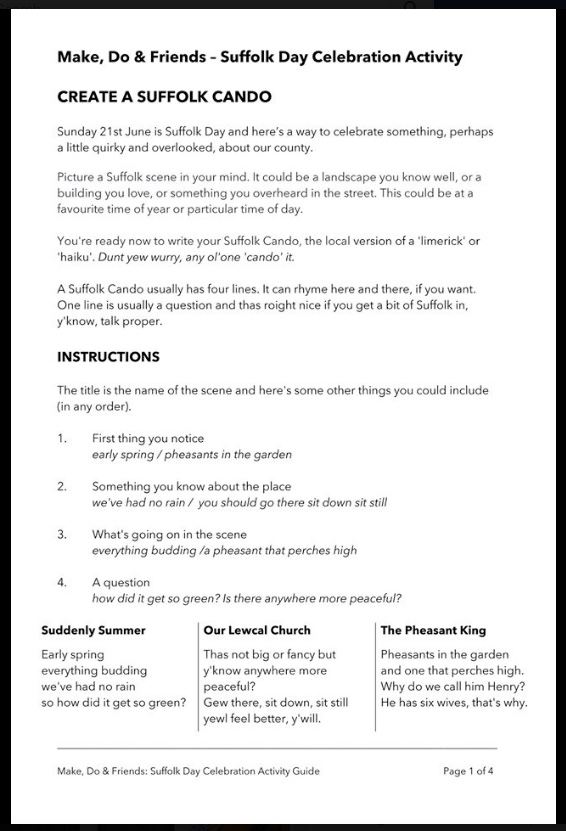
New Forms (30): the Suffolk Cando


'... so how did it get so green?' Dean Parkin (Suffolk Cando)

Have you heard of the Suffolk Cando? Poet, Dean Parkin invented the form for the Make, Do & Friends projects, organised by Suffolk Artlink and the Rural Coffee Caravan. He hopes it will help us to celebrate Suffolk Day on 21 June.

Dean describes the Suffolk Cando as a cross between a limerick and a haiku, with added Suffolk dialect thrown in. The form usually has four lines. It can include rhymes 'here and there'.

One line is usually a question, and while the inventor of the form would like to encourage a bit of 'Suffolk', he adds that 'any old dialect would do (or speech).'

The form will be premiered tomorrow on Radio Suffolk (UK) on Friday 19 June 2020 on the Lesley Dolphin show at 2.30pm.

Dean's examples:

SUDDENLY SUMMER
Early spring
everything budding
we've had no rain
so how did it get so green?

SUFFIN FOR NUFFIN
They say wos it all about?
Well, I dunt really noo.
You can do the hookey cookey
but just yew mind how yew gew.


Posted with Dean's permission.

Thursday, 30 January 2020

Poetics (6): the Epigraph

I suspect epigraphs are like a certain yeast-based spread in the sense that you either love or hate them. Dave Bonta and those who comment on his words have listed a number of reasons for their inclusion: you can find the discussion here on Via Negativa.

Wednesday, 30 January 2019

New Forms (29): the 821

Tyne Bridge at Night

The 821: you can read about it here.

Examples can be found here. 

Sunday, 4 February 2018

Tuesday, 30 January 2018

Poetics (5): the Double dactyl

Do click the link here to read more about the Double dactyl on The London Grip pages for the time being.

Thursday, 30 November 2017

New Forms (27) and (28): The Octolune... and the Octoluneo


This new poetic form, which addresses or invokes the moon, was invented by Simon Zonenblick. If you click through to Simon's post and scroll down a little, you will also be able to read about the spin-off form, the Octoluneo.

You can find details of the Octolune on the Write Out Loud site here.

Alison Lock has included an Octolune in her new collection, Revealing the Odour of Earth (Calder Valley Poetry, 2017). Hannah Stone alludes to the poem in her review here on the Algebra of Owls site.

Friday, 27 October 2017

New Forms (26): Newspaper Blackout Poems

As far as I can see, these are the same as erasure poems, except that you (only) use text from a newspaper.

See here. 

Monday, 2 October 2017

New Forms (25): The Golden Shovel


This not-quite golden (?peat) shovel is displayed in the Somerset Levels, 
having come from the China Clay Museum in Cornwall


24 November 2017 news update: there is now an international Golden Shovel competition run by Roosevelt University for young people and international undergraduate students: details here. 

* * *

I attended a poetry workshop and reading at the ¡Cornucopia! Alde Valley Festival on Saturday. One of the poems read out to us by Sue Wallace-Shaddad was in the Golden Shovel form. This was new to me. Its name immediately brought to mind not only Wordsworth's 'host of golden daffodils', but a diverse array of other 'golden' items, rules and concepts - the goose's golden eggs, the Golden Section, a golden handshake and so on.

The image that lodged most firmly in my mind was the 'Golden Marshalltown' trowel, the prized possession of an archaeologist, in The Golden Marshalltown: A Parable of the the Archaeology of the 1980s by Kent V. Flannery (American Anthropologist, New Series, Vol. 84, No. 2, June, 1982, 265-278): you can read about the article here. 

I am still trying to work out the connection between the trowel and the shovel since both (like the pen: remember Heaney) can be used for digging.

Here are a few links to websites about the new poetry form...

Tuesday, 19 September 2017

Resources (2): Martyn Crucefix on 14 Ways to Write an Ekphrastic Poem

Martyn Crucefix has written an excellent blog post here.

For the Rattle ekphrastic challenges see here. 

Friday, 26 May 2017

New Forms (24): The Cherita

The Cherita: a compact and pleasing 'short form', with a sense of narrative at its heart.
  • 'collecting dulse' [22/2017] has been published in The Cherita #3 (eBook 2017 vol i. Find Me) p.188...

Elgol, Skye shorelines